

Holiday Let Fire Safety in the Lake District: What Gets Checked
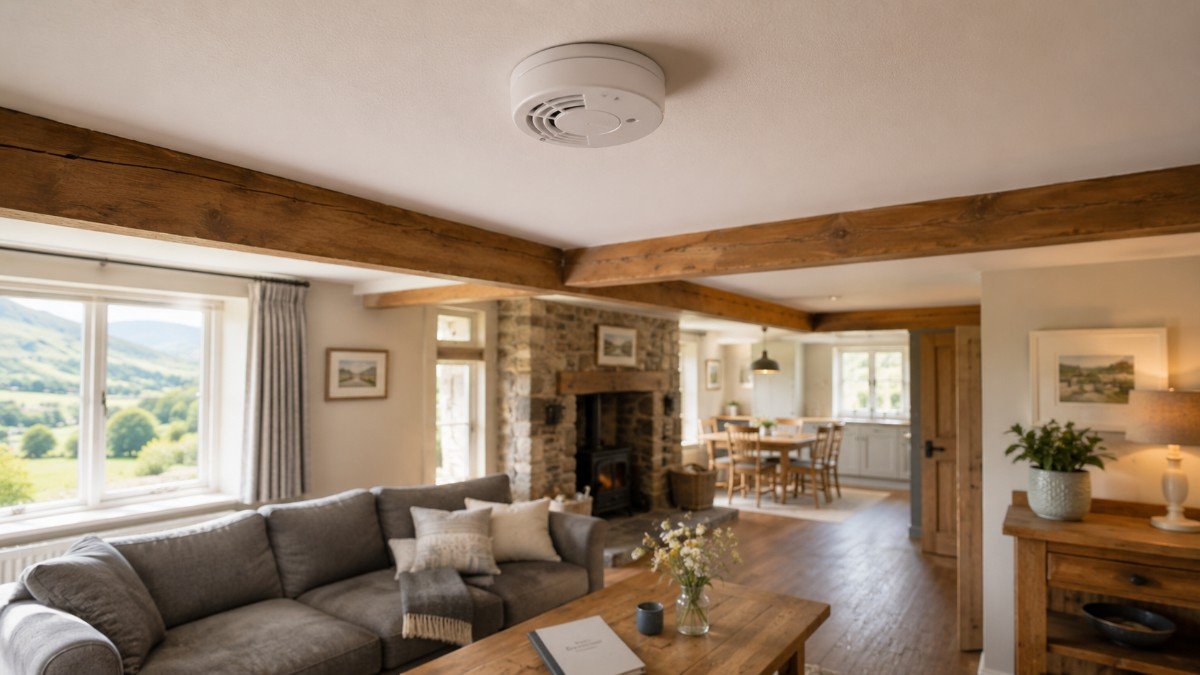
If you run a holiday let in the Lake District, fire safety compliance comes from three directions: the Regulatory Reform (Fire Safety) Order 2005 (which applies to all letting properties), your insurer’s policy conditions, and platform requirements from Airbnb or Booking.com. Getting one right doesn’t cover you for the others. This guide breaks down what each one checks, what BFP’s engineers most commonly flag during pre-season visits across Cumbria, and what you can do before your first June guests arrive.
What the law requires for holiday let fire safety
The Regulatory Reform (Fire Safety) Order 2005 applies to every holiday let in England. If guests are sleeping in your property, you are the “responsible person” under the Order. That means a property-specific fire risk assessment, working fire detection to BS 5839-6 (typically Grade D1 LD2), and appropriate provisions including extinguishers, fire blankets, clear escape routes, and emergency signage.
According to Home Office fire statistics, dwelling fires in England resulted in 247 fatalities in 2024-25. Properties where occupants are unfamiliar with the layout, like holiday lets, carry a higher escape risk than permanent homes.
What platforms and insurers actually check
Airbnb and Booking.com rely on self-declaration and guest reviews — neither sends an inspector. But if a guest reports a missing or non-working alarm, platforms can delist you immediately, and your self-declaration becomes evidence against you. Treat platform requirements as the minimum, not the target.
Insurers go further. Most holiday let policies include specific fire safety conditions, and missing even one can void a claim regardless of the fire’s cause. According to the Association of British Insurers, non-disclosure or failure to meet policy conditions is one of the top three reasons holiday let claims are declined. Pull out your schedule and check the fire safety section before peak season starts.
Your insurer won’t remind you that conditions exist. If your extinguisher service, fire risk assessment, or chimney sweep certificate has lapsed, a claim can be declined — even if the fire was unrelated to the lapsed condition. Check your policy wording now, not after a loss.
What to fix before peak season
BFP’s engineers carry out pre-season fire safety checks on holiday lets from Penrith to Ambleside, Carlisle to Coniston. The same gaps appear repeatedly — outdated risk assessments, standalone alarms that won’t wake guests two floors up, extinguishers past their service date, missing guest fire safety notices, and wood burner installations without BAFE-compliant documentation.
✓Pre-season fire safety checklist
- Check your fire risk assessment date — if over 12 months old or the property has changed, book a review.
- Test every smoke alarm and CO alarm; replace batteries or units as needed and confirm interconnection.
- Check fire extinguisher service labels — book a BS 5306-3 service if the last date is over 12 months ago.
- Confirm the fire blanket is in the kitchen and accessible, not behind a cupboard door.
- Walk the escape route at night — can a guest who has never been here find the front door in the dark?
- Review guest fire safety information: visible, current, and specific to your property.
- Check your insurance policy fire conditions and confirm every one is documented.
- If you have a wood burner, confirm your chimney sweep certificate and HETAS documentation are current and on file.
Sources & further reading
- Regulatory Reform (Fire Safety) Order 2005 — Full legislation text including Article 9 fire risk assessment duties
- gov.uk Fire Prevention and Protection Statistics — Dwelling fire incident and fatality data for England
- BAFE — Third-party accreditation for fire extinguisher and alarm servicing companies
- Fire Industry Association — Non-domestic premises fire statistics and industry guidance
Frequently Asked Questions
Do I need a fire risk assessment for a holiday let in the Lake District?
Yes. Under the Regulatory Reform (Fire Safety) Order 2005, any property where guests sleep requires a fire risk assessment carried out by a competent person. This applies regardless of whether you let through Airbnb, an agency, or privately. The assessment must be specific to your property and reviewed when the building or its use changes.
How often should fire extinguishers be serviced in a holiday let?
Fire extinguishers should be serviced annually to BS 5306-3. The service must be carried out by a competent person, and most holiday let insurers require the servicing company to be BAFE-registered. An out-of-date extinguisher can void your insurance and leaves guests without reliable firefighting equipment.
What fire alarms do I need in a holiday cottage?
At minimum, you need smoke alarms on every storey. BS 5839-6 recommends a Grade D1 LD2 system for holiday lets, which means mains-powered, interconnected alarms covering escape routes and high-risk rooms like kitchens and living rooms with open fires. Properties with solid fuel appliances also need a carbon monoxide alarm in the same room as the appliance.
Need fire protection you can trust?
Local, accredited, and covering all of Cumbria. Always happy to have a chat about what you need.
01768 863 551