
Farm Fire Safety in Winter: Barns, Sheds and the Jobs Worth Doing Now
Cumbria is farming country, and November is when the working year moves indoors. Stock comes in, the sheds fill up, heaters and lamps go on, and buildings that stood half empty all summer are suddenly full of animals, bedding and machinery. It is also the point at which fire risk on a farm changes shape, quietly, without anyone deciding anything.
Why winter changes the risk on a farm
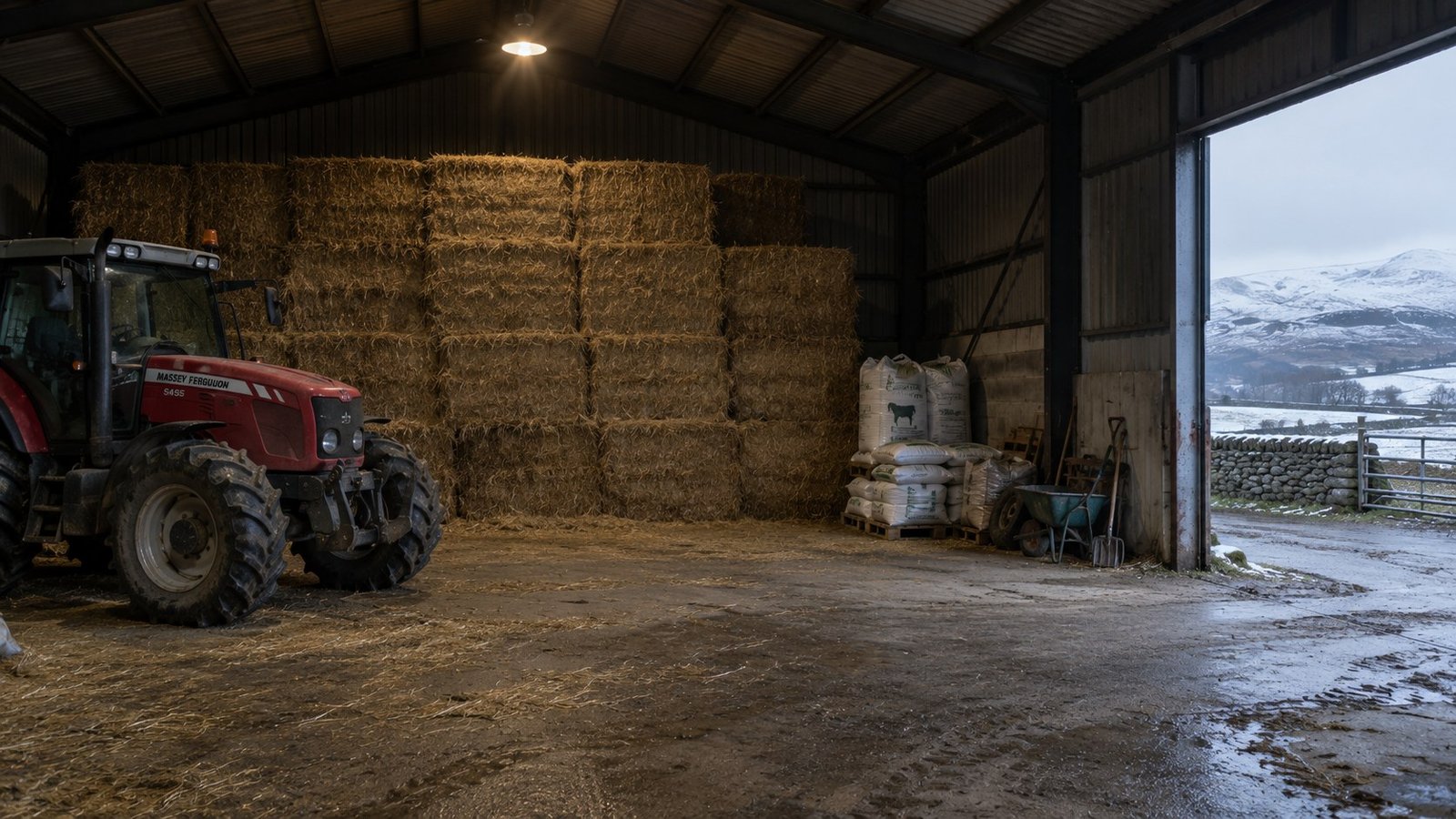
A farm building in July is mostly fresh air. The same building in December holds straw to the roof, a tractor or two, feed, fuel and livestock, with power running to lamps, heaters and water systems that were switched off for months. Nothing about that is unusual or careless. It is just that the building is doing a very different job from the one it was doing in summer.
Add the weather, and the margins get thinner. A fire in a remote barn at four in the afternoon in November is happening in the dark, often in wind and rain, down a track that a fire engine has to find. Distance is the part people underestimate. The response that would reach a unit on an industrial estate in minutes takes considerably longer to reach a farm at the end of a single track road.
Where fires tend to start in farm buildings
Three things come up again and again. Electrics are the first, and usually the oldest part of the setup: wiring run years ago for a lighter load, sockets added as needs changed, extension leads doing permanent work. Dust and cobwebs sit on all of it, and in a livestock shed so does moisture and ammonia, which are hard on cable and connections.
Heat sources are the second. Lamps over calf pens, portable heaters in the workshop, anything running overnight close to bedding. The third is what the building is full of. Straw, hay and feed burn fast and hot, and if hay has gone in slightly damp it can heat on its own without any ignition source at all.
Four things worth walking round and checking
None of this needs a project. It needs a walk round with the lights on and twenty minutes of attention.
- Look at the consumer unit and any sockets in the sheds. Scorch marks, warm plates, exposed cable or anything held together with tape needs an electrician, not a note for later.
- Check what sits within reach of every heater and lamp. A heat lamp is designed to put out heat, so the question is only what is close enough to catch.
- Find your extinguishers. Many farms have them somewhere, in date and in the wrong building. They are no use in a shed you are not standing in.
- Look at the stack. Hay baled wet heats from the inside, and a stack that is warm to the hand or steaming needs dealing with now.
Stand in your main stock shed and ask yourself where you would go for an extinguisher, and what you would do if the power went off at the same time. If the honest answer involves walking to another building in the dark, that is the gap worth closing before the weather turns.
The buildings that get forgotten
Fire safety on a farm tends to be thought about for the farmhouse, because that is where people sleep. The buildings that carry the most risk are usually the ones nobody has looked at properly in years: the old stone barn now used for storage, the lean-to with the quad and the fuel can, the workshop with the welder. If you have a fire risk assessment at all, it is worth checking whether it covers those buildings or stops at the house.
The same goes for anywhere you have diversified. A holiday let in a converted barn, a farm shop, a wedding venue or a campsite building brings different duties entirely, because the people in it do not know the way out.
Do it before the deep winter
There is a practical reason to sort this in November rather than January. The sheds are full but the real cold has not arrived, the days still have enough light to see what you are doing, and the diary is not yet taken up with lambing or whatever your calendar brings. Finding a faulty circuit now is a job. Finding it in February, after it has caused a problem, is a different conversation.
Fire safety for Cumbrian farms
Beacon Fire Protection works with farms and rural businesses across Cumbria, from single holdings to diversified sites with lettings and visitors. We service and supply extinguishers, carry out fire risk assessments, and fit and maintain alarms and emergency lighting in agricultural and commercial buildings. If you are not sure what you have or whether it still works, that is exactly the sort of thing worth a conversation.
Sources
- Home Office, Fire statistics data tables, table FIRE0301: primary fires in other buildings by motive and building type, England. Year ending March 2026. Data tables updated 30 September 2026. gov.uk/government/statistical-data-sets/fire-statistics-data-tables
- Health and Safety Executive, Electricity (agriculture topic), last updated 29 July 2024. hse.gov.uk/agriculture/topics/electricity.htm
Book a farm fire safety check
We are a local business, working with farms and rural sites right across Cumbria and the Lake District. Whenever you need us, we are just up the road.