

Fire Door Inspection & Compliance in Cumbria: What Building Owners Need to Know

Building owners in Cumbria are legally required to maintain fire doors — and many still do not. The Fire Safety (England) Regulations 2022 made quarterly inspections mandatory for flat entrance doors in most multi-occupied residential buildings. Despite this, a significant number of properties across Penrith, Carlisle, Kendal, and Barrow remain non-compliant, putting residents at risk and exposing building owners to enforcement action.
What the 2022 Regulations Changed
Before the Fire Safety (England) Regulations 2022, fire door inspection was covered broadly by the Regulatory Reform (Fire Safety) Order 2005 — but there was no specific frequency requirement. The responsible person had to ensure fire doors were maintained, but how often they checked them was left to the fire risk assessment. In practice, many buildings went years without a proper fire door inspection.
The 2022 Regulations changed that. For any building in England containing two or more sets of domestic premises — flats, apartments, HMOs, sheltered housing, care homes — there are now explicit requirements. Flat entrance doors (the door between a flat and the communal area) must be inspected quarterly. All other fire doors in communal areas — corridor doors, stairwell doors, lobby doors — must be inspected at least annually. These are minimum frequencies. If a fire risk assessment recommends more frequent checks, that takes priority.
The regulations also require the responsible person to provide residents with information about fire doors — including the importance of self-closing devices and reporting damage. If you manage a residential building in Cumbria, these obligations apply to you.
What a Fire Door Inspection Covers
A proper fire door inspection is not a quick visual glance. It is a systematic check of every component that contributes to the door’s ability to resist fire and smoke for its rated period — typically 30 or 60 minutes. Here is what our engineers assess on every door.
Fire Door Inspection Checklist
- Door leaf condition — no holes, cracks, delamination, or unauthorised modifications
- Intumescent strips and smoke seals — intact, continuous, not painted over or damaged
- Self-closing device — door closes fully into the frame from any angle without manual assistance
- Gaps — maximum 3mm around the top and sides when closed, no gaps allowing smoke passage
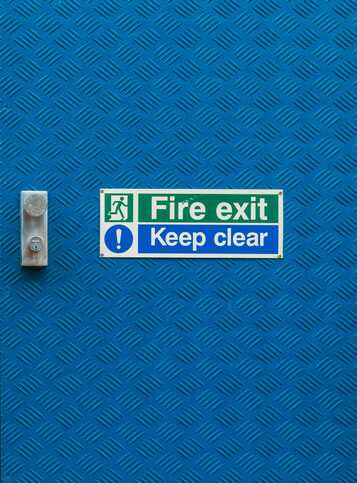
- Signage — correct fire door keep shut (or keep locked) signage in place
- Frame condition — solid, securely fixed, no damage or distortion
- Hinges — minimum of three, CE-marked, securely fixed with no missing screws
- Glazing — fire-rated glass with correct beading and intumescent glazing tape
- Letterbox — fitted with an intumescent letterbox protector if present
Each item matters. A fire door is a complete assembly — if one component fails, the door’s fire rating is compromised. A door that looks fine but has painted-over intumescent strips will not expand to seal the gap when exposed to heat. A door with only two hinges instead of three will warp and fail under fire conditions.
Common Failures We Find in Cumbria
After carrying out fire door inspections across Cumbria for years, the same failures come up repeatedly. Knowing what to look for can help building owners identify problems before a formal inspection — but it does not replace one.
Painted-Over Intumescent Strips
This is the most common issue we find, particularly in older buildings across Carlisle and Penrith that have been redecorated multiple times. When intumescent strips are coated in layers of paint, they cannot expand properly when heated. The strip needs to swell to many times its original size to seal the gap between door and frame — paint prevents that. The door looks fine but will fail in a fire.
Missing or Defective Self-Closers
Self-closing devices must close the door fully into the frame from any open angle. We regularly find closers that have been removed, adjusted to hold the door open, or that no longer generate enough force to latch the door. In care homes and sheltered housing, residents sometimes remove closers because they find the doors heavy. This is understandable — but it is a serious fire safety breach. The solution is a hold-open device connected to the fire alarm, not removal of the closer.
Propped-Open Fire Doors
Wedges, door stops, hooks, and even fire extinguishers used to hold fire doors open remain common across Cumbria. A fire door that is propped open is not a fire door — it is a hole. In a fire, smoke and toxic gases will spread freely through the opening. If doors need to be held open for operational reasons, the only compliant option is a hold-open device linked to the fire alarm system that releases automatically on activation.
Other Common Issues
We also frequently find damaged or missing smoke seals, non-fire-rated glazing installed as replacements during general building maintenance, incorrect gap sizes caused by frame movement or building settlement, and missing signage. In older hotel and guest house buildings around Kendal and Windermere, we sometimes find fire doors that have been replaced entirely with non-rated alternatives during renovation — often without the building owner realising the implication.
Why Local Inspection Matters
Cumbria’s building stock is distinctive. Listed buildings in Penrith and Carlisle present particular challenges — historic timber frames, non-standard door sizes, and restrictions on what modifications can be made. Older hotels and guest houses in the Lake District often have fire doors from different eras, each with different specifications. Care homes across the county have high-traffic doors that wear faster than residential equivalents. A fire door inspector who knows these building types will spot issues that a generic assessor might miss.
Beacon Fire Protection covers Penrith, Carlisle, Kendal, Barrow, Windermere, and all of Cumbria. We carry out fire door inspections to the standards required by the Fire Safety (England) Regulations 2022, provide clear written reports identifying every defect, and can carry out remedial work — from replacing intumescent strips and smoke seals to fitting new self-closing devices and fire-rated glazing.
If you are a building owner, managing agent, or responsible person for a multi-occupied building in Cumbria, quarterly fire door inspections are not optional. They are a legal requirement. If you have not started, now is the time.
Book a fire door inspection
Covering Penrith, Carlisle, Kendal, Barrow, Windermere, and all of Cumbria. We will check every fire door and give you a clear report.
Call 01768 863 551 info@beaconfireprotection.co.uk