
Fire Extinguisher Servicing & Training in Cumbria & Dumfries and Galloway
Every fire extinguisher in a workplace needs annual servicing under BS 5306-3 — and staff need to know how to use them. Across Cumbria and Dumfries & Galloway, many businesses are behind on both. Here is what the law actually requires, what each type of extinguisher covers, and how practical training keeps your team safe and compliant.
What BS 5306-3 Requires
BS 5306-3 is the British Standard that governs fire extinguisher maintenance. It is not optional — if you have extinguishers on your premises, they must be serviced in line with this standard. Your insurer will expect it, and a fire safety inspector will ask to see the records.
Every extinguisher needs a basic annual service. This covers a visual inspection, weight check, pressure gauge reading, condition of seals, and tamper indicators. The engineer checks that the extinguisher is in the right location, clearly visible, and has the correct signage above it.
At the five-year mark, an extended service is required. This is more involved — the extinguisher is discharged, internally inspected, recharged, and pressure tested where applicable. Discharge testing intervals vary by type: CO2 extinguishers require hydraulic testing every 10 years, while stored-pressure units need discharge testing every 5 years.
The hard limit is 20 years. After that, every extinguisher must be replaced regardless of condition. There are no exceptions.
The Five Types of Extinguisher
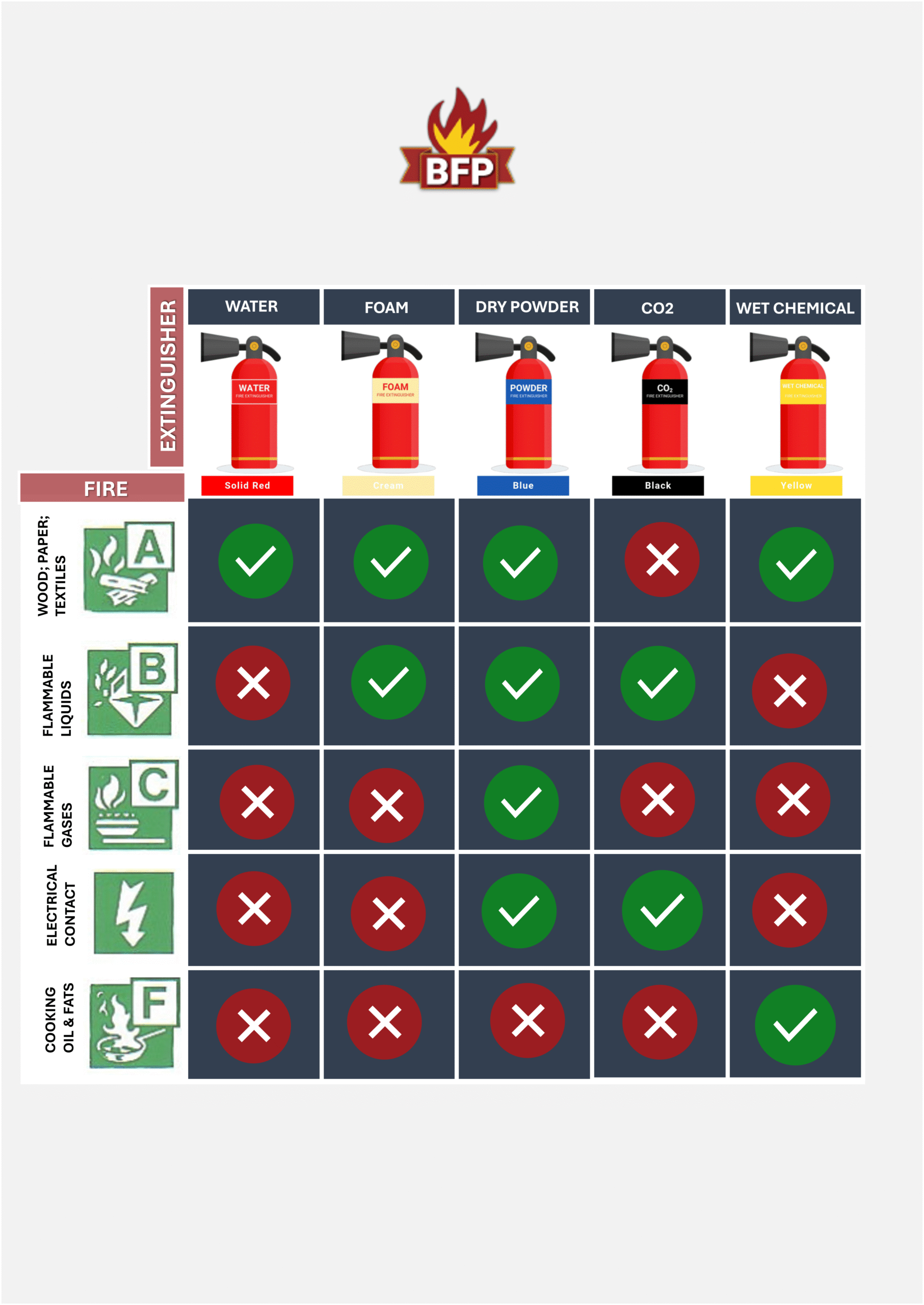
Not every extinguisher works on every fire. Using the wrong type can make things worse — spraying water on a chip pan fire or an electrical fault is dangerous. Your fire risk assessment determines which types you need and where they should be positioned.
Extinguisher Types & Coverage
- Water (red label) — Class A fires: paper, wood, textiles, and other solid combustibles
- Foam (cream label) — Class A and B fires: solids plus flammable liquids such as petrol and paint
- CO2 (black label) — Electrical fires and Class B flammable liquids — leaves no residue, safe for server rooms and offices
- Powder (blue label) — Class A, B, and C fires: the most versatile, but creates a dense cloud that reduces visibility — use only where alternatives are not practical
- Wet Chemical (yellow label) — Class F fires: cooking oils and deep fat fryers — the only type rated for commercial kitchen fires
Most businesses need at least two types. A standard office typically requires water or foam extinguishers for general risks plus CO2 units near electrical equipment. Any premises with a commercial kitchen needs wet chemical extinguishers. Our extinguisher servicing covers all five types to BS 5306-3.
Do Staff Need Extinguisher Training?
Yes. The Regulatory Reform (Fire Safety) Order 2005 requires the responsible person to provide adequate fire safety training to all employees. This includes instruction on how to use fire extinguishers — not just where they are, but how to operate them safely and which type to use on which fire.
Reading a laminated card on the wall is not the same as actually using an extinguisher under pressure. Practical, hands-on fire safety training is the most effective approach. Staff practise with real extinguishers in supervised live fire exercises. They learn the PASS technique (Pull, Aim, Squeeze, Sweep), understand the differences between extinguisher types, and build confidence to act quickly rather than freeze.
We run practical training sessions at your premises — no need to send staff off-site. Sessions typically last around two hours and cover both theory and live use. Training should be refreshed annually or when new staff join.
Covering Cumbria and Dumfries & Galloway
Beacon Fire Protection is based in Penrith and covers the full Cumbria region — from Carlisle in the north to Barrow-in-Furness in the south, and from the West Coast through to the Eden Valley. We also service businesses across the border in Dumfries and Galloway, where we are one of the few companies appearing in Google for fire extinguisher testing in D&G.
Whether you run a Lake District hotel, a farm, a school, a care home, or an industrial site, we carry out servicing and training on-site at a time that works for you. We also handle extinguisher servicing in Penrith and the surrounding towns on regular routes, keeping call-out costs down.
If your extinguishers have not been serviced this year, or your staff have never had hands-on training, now is the time to sort it. A failed extinguisher or a panicked employee is not a risk worth taking.
Book extinguisher servicing or training
We service every type of extinguisher to BS 5306-3 and run practical training sessions at your premises. Covering all of Cumbria and Dumfries & Galloway.
Call 01768 863 551 info@beaconfireprotection.co.uk