


How Often Should You Test Your Fire Safety Equipment?
Fire safety equipment only works if it actually works. That sounds obvious, but you would be surprised how many businesses install fire alarms, extinguishers, and emergency lighting and then forget about them for years. Regular testing is not optional. It is a legal requirement under the Regulatory Reform (Fire Safety) Order 2005, and it could genuinely save lives.
The Testing Schedule You Need to Follow
Different equipment needs testing at different intervals. Some checks are quick and easy enough for any member of staff to carry out. Others require a qualified technician with specialist tools. The table below lays out the full picture.
| Equipment | Weekly | Monthly | Annually | 5-Yearly |
|---|---|---|---|---|
| Fire alarms | ✓ Call point test | – | ✓ Full service | – |
| Fire extinguishers | ✓ Visual check | ✓ Pressure gauge | ✓ Professional service | ✓ Discharge test |
| Emergency lighting | – | ✓ Function test | ✓ 3-hour duration test | – |
That five-yearly discharge test for extinguishers is worth flagging. It applies to water, foam, and powder types, and it is often more cost-effective to simply replace the extinguisher than to pay for the test itself. Your servicing engineer should be able to advise on that.
What Each Check Actually Involves
Knowing the schedule is one thing. Knowing what to look for is another. Here is what you should be checking for each piece of equipment.
Fire Alarm Weekly Test
- Activate a different call point each week (rotate through them all)
- Confirm the panel receives the signal and the sounders activate
- Check the alarm is audible in all occupied areas
- Log the test with the date, call point tested, and result
- Reset the system and confirm it returns to normal operation
Rotating through different call points matters. If you test the same one every week, you will never know whether the others are faulty until it is too late. Some people also test at the same time each week so staff recognise it and do not evacuate unnecessarily, though that is up to you.
Fire Extinguisher Checks
- Extinguisher is in its designated position and clearly visible
- No physical damage, dents, or corrosion to the body
- Safety pin and tamper seal are intact
- No obstructions blocking access to the extinguisher
- Pressure gauge reads within the green zone (monthly)
- Operating instructions label is legible and facing outward
- Annual service completed by a competent person to BS 5306-3:2009
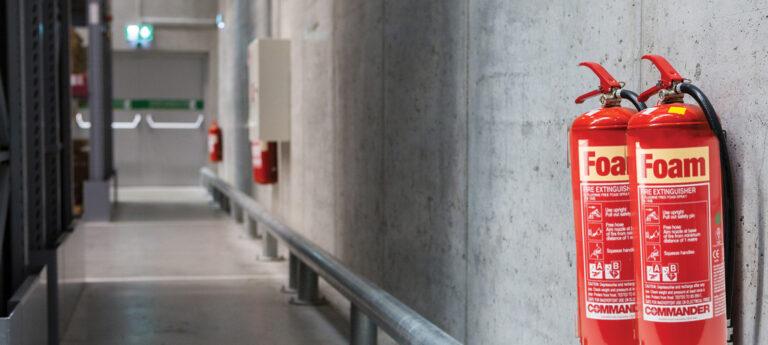
BS 5306-3:2009 is the British Standard covering maintenance of portable fire extinguishers. Your annual service must be carried out by someone competent, which in practice means a certified fire extinguisher technician. They will check internal components, replace seals if needed, and confirm the extinguisher is still fit for purpose.
Emergency Lighting Tests
- Monthly flick test: switch off mains, confirm all units illuminate
- Check for any units with dim or flickering output
- Verify charging indicators are showing normal status
- Annual 3-hour duration test to confirm full battery capacity
- Record all results in the building’s fire safety log book
The monthly function test is straightforward. You cut the mains supply and confirm each unit lights up. It only needs to run for a few seconds. The annual test is more involved. The lights need to run for a full three hours on battery power to prove they can last through an extended power cut. That one needs planning because your escape routes will be without normal lighting during the test. Most businesses schedule it outside of working hours and bring in a professional to oversee it.
Your Weekly Fire Safety Routine
It helps to batch your weekly checks into a single routine. Pick the same day each week, assign it to a specific person, and keep a written log. Here is a sensible order to work through.
Walk the building
Start with a walkthrough of every floor. Check that fire exits are clear, fire doors close properly, and nothing is blocking escape routes.
Inspect all extinguishers
Confirm each extinguisher is present, undamaged, and accessible. A missing or obstructed extinguisher is a compliance failure waiting to happen.
Test one fire alarm call point
Use your rotation schedule to select which call point to test this week. Confirm sounders activate across the building, then reset.
Check fire safety signage
Make sure Fire Action Notices, extinguisher ID signs, and exit signs are all in place and legible. Replace any that are faded or damaged.
Log everything
Record the date, who carried out the checks, what was tested, and whether any issues were found. This log is your evidence of compliance if you ever face an inspection.
The whole routine should take 15 to 20 minutes for a small to medium premises. That is a small investment against the consequences of equipment failing during a real fire.

The thing is, none of this is difficult. It just requires consistency. The Regulatory Reform (Fire Safety) Order 2005 places the duty on the “responsible person” for your premises, which is usually the employer, owner, or occupier. If your local fire authority inspects and finds equipment that has not been tested, the consequences range from enforcement notices to prosecution. It is not worth the risk.
That said, not every business has the time or expertise to manage all of this in-house. Plenty of our clients across Cumbria and the Lake District rely on us to handle the professional servicing and annual tests while they take care of the simpler weekly checks themselves. It works well as a shared approach.